By MIKE RALEY WPTF Weekend Gardener
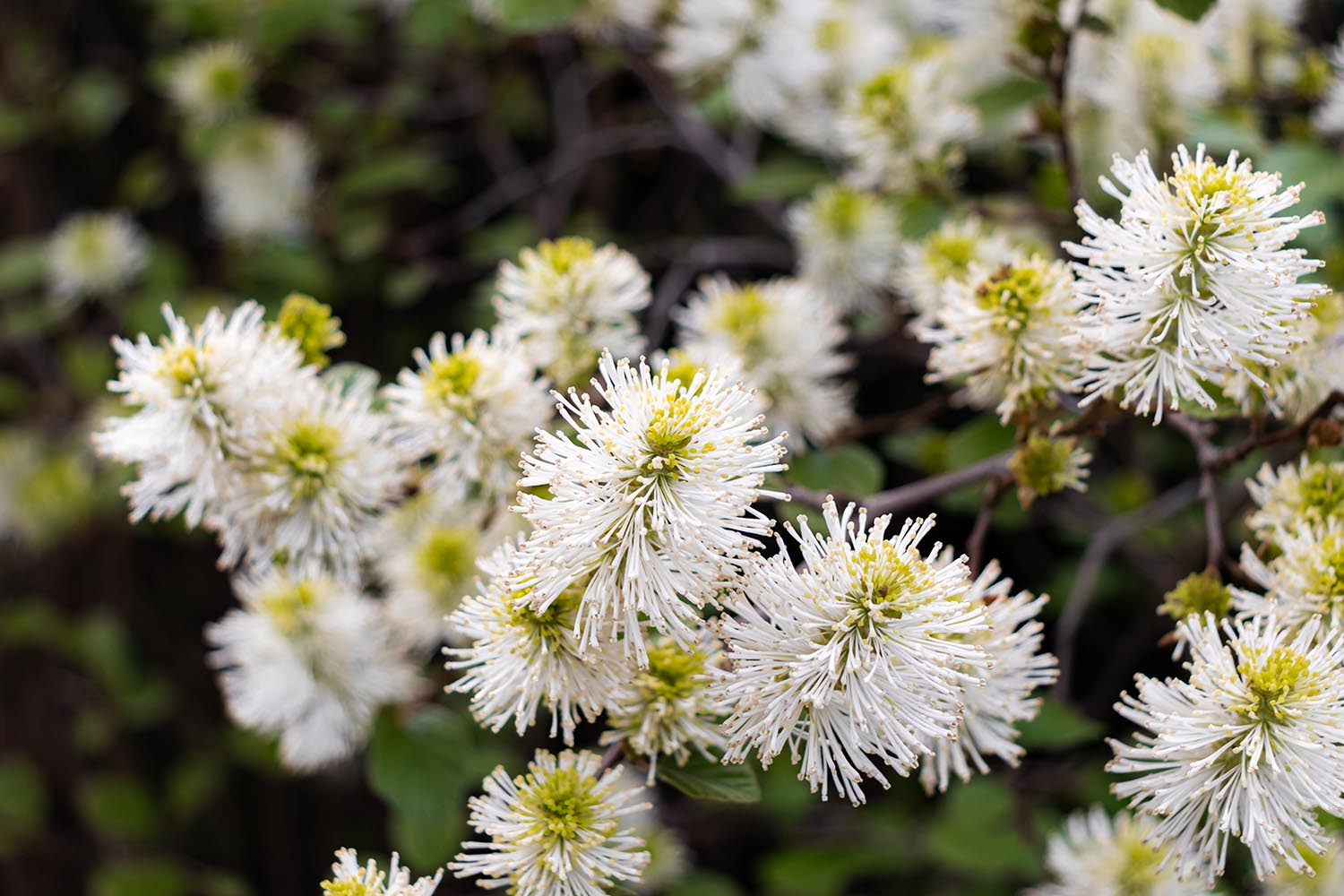
If you have ever wanted to grow your own bottle brushes, then you have come to the right place. The Fothergilla latifolia or F. major or the Dwarf Fothergilla (gardenii) is what you have been looking for. It has another cool name: “Witch Alder.” Actually, this plant is not in the alder family, it just resembles the alder trees. The Fothergilla is actually kin to the Witch Hazel.
This deciduous shrub has a lot more going for it than the characteristics of its leaves or the shape of its flower which is about 3 inches long. It is quite interesting with the curious-looking spring flowers that last 2 to 3 weeks and have a faint honey fragrance. The witch hazel-looking leaves have breathtaking fall color. They are known for their combination of bright red, orange, yellow, and purple hues. During the winter, it presents as an open and unusually shaped shrub. The Fothergilla can grow to a height of 12 feet and a width of 10 feet at maturity, while the dwarf varieties will reach 3 to 4 feet tall and wide.
Fothergilla is native to North Carolina with the taller version being found in the piedmont and mountains, and the dwarf variety more at home in the coastal plain and coastal regions. Find a spot to plant this gem in full sun to part shade. In hotter areas of the state, it may actually prefer some afternoon shade. Fothergilla also prefers well-draining acid soil that holds some moisture, but it does not like wet feet. It is usually drought-tolerant once established.
Plant your Russian Sage by using a sharp shovel. Anne Clapp always recommended that. Dig a hole that is at least twice as wide as the root ball and just as deep. Place your shrub in the hole, gently spreading out the roots, and then backfill to ground level or slightly above and water well. To get your plant off to a good start, incorporate some organic matter in the soil, and cover the root zone with a layer of mulch. If you feel you must fertilize your Fothergilla, use an acid-forming fertilizer, something like Espoma’s Hollytone.
There are really no insect or disease problems associated with the Fothergilla according to the experts at the North Carolina Cooperative Extension Service. Deer don’t seem to care for them and leaves and flowers don’t seem to be poisonous to humans or pets.
Since Fothergilla is a spring-blooming plant, you should prune just after it blooms. It blooms on old wood or last year’s growth, so prune when the bloom fades. Dead or diseased branches can be removed most anytime. You should also prune branches that touch or cross each other. The Fothergilla does produce suckers at the base that should be pruned at the base with a shovel if possible.
You can take cuttings from Fothergilla in June to share or plant somewhere else.
There are hybrid cultivars of Fothergilla that are recommended by NC State University. There is “Mt Airey”, (I’d plant this one since it is named for Andy Griffith’s hometown), “Blue Shadow”, “Blue Mist”, “Gardenii”, Suzanne”, and “Legend of Fall”. The folks who are a part of the WPTF Weekend Gardener family of experts normally tell us to buy named varieties, unless you receive a “passalong plant” from a friend, then take what you can get.
Hopefully, I have convinced you to buy a Forthergilla for your landscape. If for no other reason than it is an unusual-looking shrub with 4-season interest and you will probably be the only neighbor with this native, truly fascinating plant.