By MIKE RALEY WPTF Weekend Gardener
I must say from the outset that Melissa and I have never gotten around to planting a night-blooming anything. I have had to do some research on this little number. Melissa’s mom, Miss Jean, had an eye-catching night-blooming plant that you could see when looking out of the glass windows at the front door and the kitchen window of her beautiful farmhouse in Chatham County. She would pull up a chair, sometimes with a friend, to watch the beautiful white blossom open. I’m sure most of my “Weekend Gardener” buddies have one planted. I am absolutely certain that brother Rufus and Nelsa Cox have planted Moonflowers or Moonvine, also known as (Ipomoea alba) somewhere in their packed landscapes. But not procrastinating old me! This research has really renewed my interest in the night bloomers.
The native version Moonflower is known as Carolina Moonseed or (Coculus Carolinus) and produces insignificant green flowers and red berries. The berries are pretty on this perennial vine that is more versatile than the white moonflower, growing in sun and partial shade. Provide a trellis or a fence to support this variety.
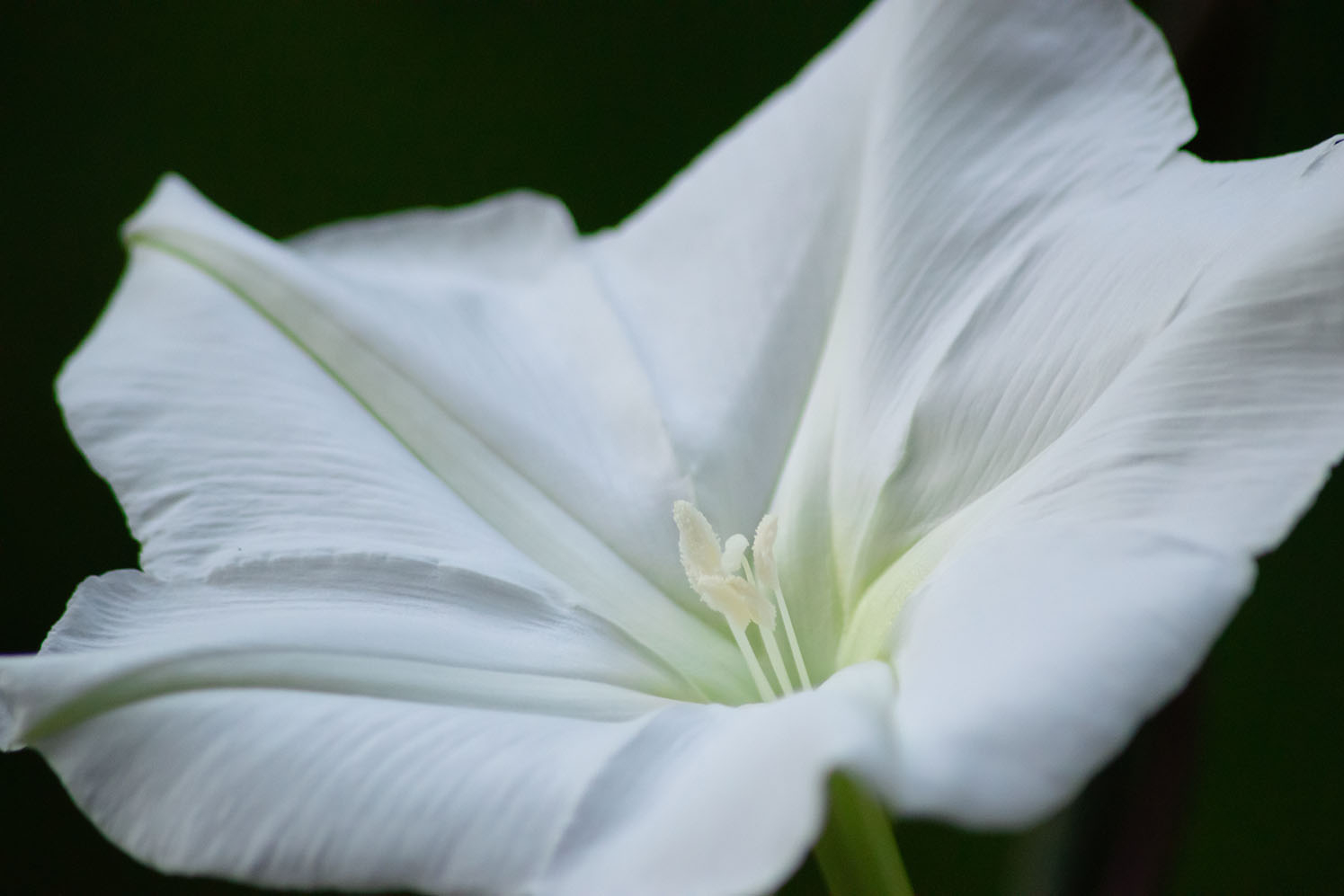
Such a fascinating group of plants that are considered tropical and native to parts of North, Central and South America including Mexico and Florida. The real reason we plant these vines or any other night-blooming species is spectacularly fragrant, large white trumpet-like flowers and the large leaves. Each flower blooms at dusk and lasts only for one night. The Moonflower is in the morning glory family and the family likeness is quite obvious.
A real plus for me is that the Moonflower is low maintenance. It is generally an annual in North Carolina and therefore is not reliably perennial. If you live on the southeast coast, mulch well, and when we have a mild winter, which we often have now, you may get lucky. Your plant may survive for another year and drop some seeds. Each year, you may start your moonflower seeds indoors-maybe 6 to 8 weeks before the last frost, which in the Raleigh area, is generally around April 15th. Another option is to start them in the ground outside after the last frost. The seeds have a hard coating and you may need to soak and scarify or scratch the seed coating to allow germination. When you plant your seeds, do so in a full sun location, with at least six hours of sun. Plan to collect the seeds in the fall when they turn brown, in case your moonflower does not survive the winter or you want to share it with friends .
Plant in a location that drains well with neutral to slightly acidic soil. Water in dry periods. My friends at NC State tell me the moon vine is a heavy feeder so you may use a balanced, time-released fertilizer like “Plant-tone” from Espoma. If you don’t like using commercial fertilizers, use some hardwood, pine bark or pine straw as mulch.
This unique flower attracts pollinators, moths and bats, just like its daytime brethren. It might be interesting to view this process with a device using night-vision. No matter how you view the opening of a moonflower, the stark white on a full moon night can be spectacular. The flowers will continue to come from October to November from west to east in the state.
We all need support in life and the moonflower vine is no different. A fence, trellis or some other type of structure may be used for proper support. The flowers will start to appear sometime during early to mid-summer depending on what part of the state you reside.
When it comes to insect or disease pests, don’t worry about it unless you live in a tropical area. Don’t worryand there are none in the Tarheel state.
Since I don’t have enough sun in my landscape to support one, let me know if you have a moon vine and we will plan a viewing party!